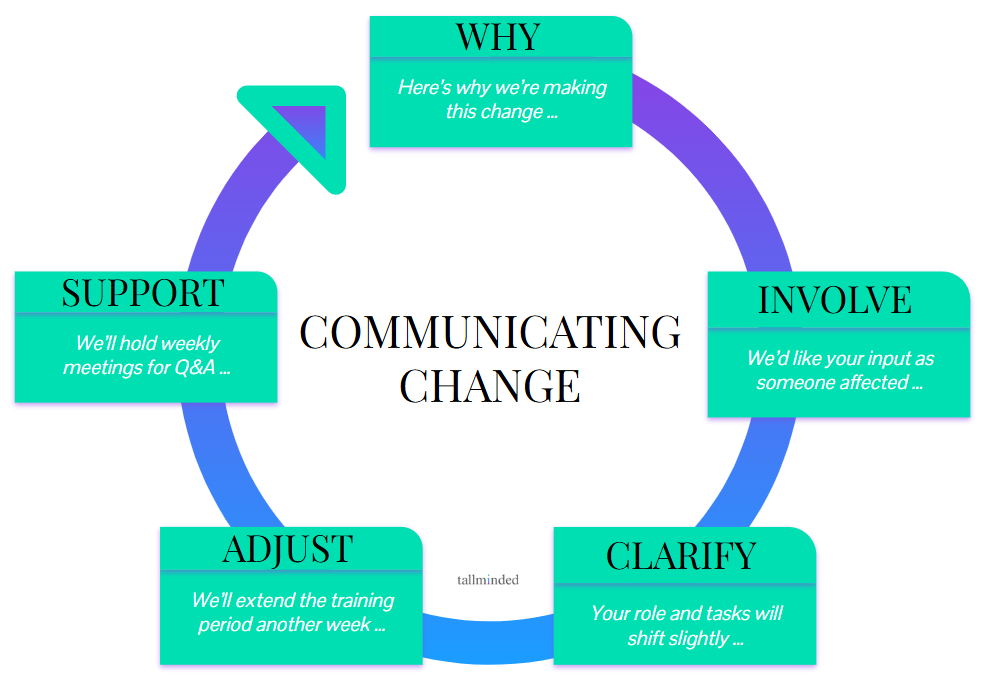
Change is necessary for growth. Whether you’re rolling out a new strategy, refining a process, or overhauling operations, the way you manage and communicate change will determine whether your team embraces it—or resists it.
At tallminded, we often see leaders focus heavily on the technical side of change (the “what” and the “how”) but underestimate the human side (the “why” and the “impact”). Both are essential to success.
Here’s how to navigate change in a way that keeps your team aligned, confident, and moving forward.
1. Start With the “Why”
Employees want to know why the change matters. Instead of leading with logistics, start by answering:
- What problem are we solving?
- How will this benefit the team, the company, and the individual?
- What risks exist if we don’t make this change?
When people see the purpose, they’re far more likely to support the plan.
2. Communicate Early—and Keep Communicating
Silence breeds resistance. Don’t wait until every detail is finalized to start talking. Instead:
- Announce early that change is coming.
- Share what you know, what you don’t know yet, and when updates will come.
- Use multiple formats—team meetings, emails, one-on-one check-ins—to meet people where they are.
Consistency builds trust, even if all the answers aren’t available yet.
3. Involve People in the Process
Change done to people sparks pushback. Change done with people creates ownership. Invite input by:
- Piloting new processes with a small group before full rollout.
- Asking frontline employees for feedback—they see operational realities leaders often miss.
- Letting people suggest tweaks that make adoption smoother.
When employees feel heard, they’re more likely to adopt and champion the change.
4. Clarify Roles and Expectations
Change often brings uncertainty: “What does this mean for me?”
Leaders must clearly define how roles, responsibilities, and priorities will shift. Create clarity by:
- Outlining what stays the same and what changes.
- Setting measurable expectations.
- Providing support resources (training, templates, checklists).
Clarity reduces anxiety and accelerates execution.
5. Lead With Empathy and Accountability
Change can be uncomfortable. Some will adapt quickly; others may resist. Great leaders balance empathy with accountability by:
- Acknowledging concerns instead of dismissing them.
- Recognizing small wins along the way.
- Holding firm to timelines and goals once decisions are made.
The combination of understanding and consistency gives your team confidence in leadership.
6. Monitor, Adjust, and Reinforce
Even the best-planned changes need fine-tuning. Track progress by asking:
- Are the new processes being followed?
- What results are we seeing?
- Where are people getting stuck?
Celebrate progress, adjust where needed, and reinforce why the change matters to keep momentum alive.
The Bottom Line
Change isn’t just about implementing a new strategy or process—it’s about leading people through uncertainty. When you pair clear communication with thoughtful involvement and accountability, you turn change from a disruption into an opportunity for growth.
At tallminded, we help companies not just design better operations, but also implement them in a way that sticks. Because the right strategy is only as strong as your team’s ability to adopt it.